The Boxer, the Interpreter, and the Coloured Section
Ocean View Burial Park was established in 1918 as Burnaby's first non-sectarian cemetery, receiving its first interments the following year. In 1929, it created a section for "any person of colour." Buried there: the first Chinese-born Canadian, a court interpreter who fought for rights he was never granted in life. Nearby, in a pauper's grave: the only Canadian-born world heavyweight boxing champion, five-foot-seven and ordained.
Ocean View Burial Park was established in 1918, one year after Burnaby's incorporation, and opened for interments in 1919 on forty acres of Imperial Street. It was British Columbia's first non-sectarian, for-profit cemetery. Albert F. Arnold designed the grounds — ornamental trees, shrubs, flowerbeds arranged in the park-cemetery style that was fashionable in the years after the First World War. The dead would rest among landscaping. The living would visit without feeling like they were visiting the dead.
Walk the paths today and you can still feel Arnold's hand in the layout. The Douglas firs have had a century to thicken. The grass is cut short and even. Headstones from the 1920s sit low in the ground, their edges softened by weather, the letters filling in with moss.
The cemetery accepted everyone. That was the point. Non-sectarian meant no single church controlled the gates. But everyone and anyone turned out to mean different things.
The section was called Willow
In 1929, Ocean View designated a portion of its grounds for "any person of colour." The official name was the Willow section. The informal name, used by staff and visitors for decades, was "Mongolia."
The segregation was policy. A person of Chinese, Japanese, South Asian, or Black descent who died in the Burnaby area would be buried in Willow, apart from the white dead. A family that had lived beside their neighbours for forty years would be separated from them in the ground. According to cemetery records, the arrangement persisted into the 1970s — long past the repeal of most of the laws that had made such arrangements feel ordinary.
A dedicated Chinese community mausoleum was eventually built within the section, so that families could at least rest together among their own. For some families, this was a consolation. For others, it was a second sorting. The answer depended on who was telling the story.
Today, Ocean View covers one hundred acres. Over 100,000 people are interred there. The Commonwealth War Graves Commission maintains military graves on the grounds. The Abbey Mausoleum, designed by San Francisco architect Wallace H. Hubbert, has been expanded four times since its first wing went up in 1928. Only one wing was completed before the Depression killed the budget. Construction resumed in 1946.
Won Alexander Cumyow was born at Port Douglas, British Columbia, in 1861
His father, Won Ling Sing, was a merchant who had arrived during the Gold Rush. The family settled. Won Alexander Cumyow grew up in New Westminster, attended public schools — one of the very few Chinese students admitted — and became fluent in English, Cantonese, Chinook Jargon, and several other Chinese dialects.
He was, by any reasonable measure, a Canadian. Born in the colony that would become part of Canada. Educated in its schools. He spoke its trade language and its colonial language. He married Ye Eva Chan in 1889. They had ten children. His son Gordon became the first Chinese-Canadian notary public in British Columbia.
For decades, Cumyow worked as a court interpreter for the Vancouver Police Department. He translated between English and Cantonese, between the legal system and the people it processed. He helped found the Chinese Benevolent Association and the Chinese Empire Reform Association. He spent his adult life inside institutions that governed the country he'd been born in.
He was never allowed to vote.
The provincial and federal franchise laws excluded people of Chinese descent regardless of birthplace. Cumyow was born before Confederation. He outlived the Exclusion Act. He watched the franchise expand to include women, returned soldiers, naturalized citizens from dozens of countries. He watched it stop at him.
He died in 1955, at ninety-four. He was buried in the Willow section at Ocean View — the coloured section, for any person of colour, in the cemetery that accepted everyone.
In 2024, the Government of Canada recognized Won Alexander Cumyow as a person of national historic significance through Parks Canada. The recognition came sixty-nine years after his death. He had been significant his entire life. The country needed sixty-nine of those years to say so.
Tommy Burns weighed 175 pounds and stood five feet seven inches
He was born Noah Brusso in Hanover, Ontario, in 1881. He changed his name when he started fighting professionally, which was sensible, because Noah Brusso does not sound like a man who could beat someone unconscious.
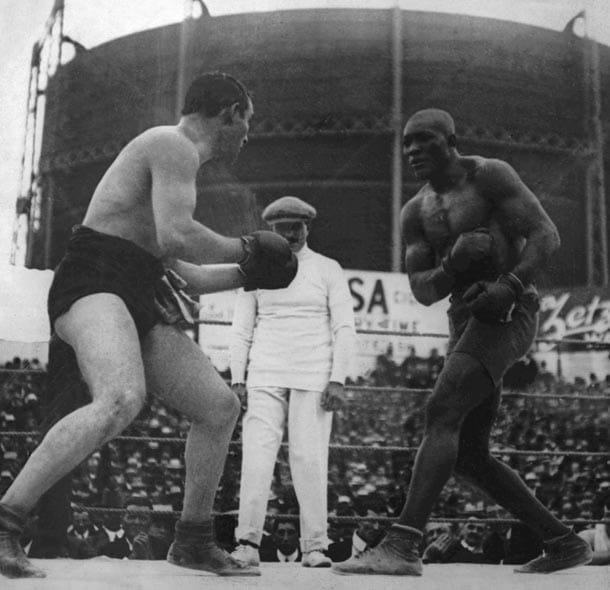
Burns became the world heavyweight boxing champion in 1906. He remains the only Canadian-born fighter to hold that title. He defended it eleven times. At five-foot-seven and 175 pounds, he was the shortest and lightest heavyweight champion in the history of the division. He fought larger men repeatedly and won.
On December 26, 1908, in Sydney, Australia, he fought Jack Johnson. Burns had agreed to a guaranteed purse of $30,000 — an extraordinary sum, the largest in boxing at the time — regardless of the outcome. The fight lasted fourteen rounds before police entered the ring and stopped it. Johnson won. He became the first Black heavyweight champion of the world. The racial significance of the bout was enormous, and it fell on Burns to be the man who lost.
Burns kept fighting for a few more years. He ran a pub. He went broke. In 1948, at sixty-seven, he was ordained as a minister. He preached. He moved to Coalinga, California, then returned to the Vancouver area. He had no money left.
He died in 1955 — the same year as Cumyow — and was buried in an unmarked pauper's grave at Ocean View.
The boxer was white, so he was not buried in the Willow section
He was buried without a marker, without ceremony, without the funds to purchase a headstone. The man who had once commanded a $30,000 purse in front of thousands went into the ground anonymously. For six years, nothing indicated he was there.
In 1961, boxing fans raised enough money to install a bronze memorial plaque in the Abbey Mausoleum. The plaque commemorates Burns. His actual grave, somewhere in the cemetery grounds, remained unmarked.
Cumyow, by contrast, has a headstone. He has a grave in a designated section. He has the 2024 Parks Canada recognition. The system that segregated him in life and in death at least acknowledged his location.
Burns had the freedom to be buried anywhere on the grounds. He ended up nowhere in particular. Two kinds of disappearing.
Klondike Kate rests in the Abbey Mausoleum
Katherine Ryan, born in Johnville, New Brunswick, in 1867, joined the Klondike Gold Rush in 1898. She earned the name Klondike Kate on the northern frontier. She died in 1932 and was placed in the mausoleum that Hubbert had designed four years earlier — the one wing that got built before the Depression.
Her presence in the Abbey is noted in local heritage guides. She had the right name, the right story, the right era — and, critically, the right category. The cemetery's sorting system had no need to reclassify her. She went into the mausoleum as a matter of course. Burns's plaque hangs nearby. Cumyow lies in Willow. Three people from three entirely different chapters of Canadian history, filed in the same hundred acres, sorted by the logic of their era. What the cemetery remembers about each of them has less to do with what they accomplished than with which section they qualified for.
Ocean View is still operating
One hundred acres, a century of burials. The Willow section is no longer segregated. The Chinese community mausoleum still stands. The Abbey has been expanded four times. The ornamental trees that Arnold planted have had a hundred years to grow.
The cemetery's original promise — non-sectarian, open to all — was real and was also a lie, in the way that many Canadian promises of the early twentieth century were. The gates were open. The grounds were divided. The dead were sorted by the same categories that had sorted the living, and the sorting outlasted every person who designed it.
Cumyow interpreted the law for decades. Burns threw punches for a living and then found God. Both died in 1955. One was placed in a section named after a tree and nicknamed after a country. The other was placed in the ground without a name at all.
The cemetery does not explain this. It holds them both and lets the hundred acres speak for themselves, which they do, if you read the map carefully.
Editor & Publisher
Artom Butenko
Founder and editor of 8 Pages Burnaby. Writes the fact-dense, archival pieces — origins, infrastructure, and the documents that explain how the city works.
More from April 2026
Full issue →
Oakalla: The Prison That Became a Neighbourhood
For eighty years, a 185-acre prison farm stood beside Deer Lake. Inmates grew vegetables, milked cows, and were hanged in an abandoned elevator shaft. A doctor gave them new faces. A punk bassist served time in the cells. When the last inmates left in 1991, the city tore everything down and sold townhomes on the land. The bricks from the cellblocks line the new walkways.
Artom Butenko · 8 min read
The Secret Submarines of Barnet Beach
During the First World War, 460 workers assembled submarine hulls for the Russian Imperial Navy on a Burnaby beach. The official story was barges. Guards patrolled behind barbed wire. Three hulls were finished before the Revolution ended the contract in 1917.
Artom Butenko · 5 min read
A Bungalow with No Bedrooms: The Disguised Tunnel Shaft on Frances Street
3911 Frances Street has hedges, a mature tree, wrought-iron fencing, and no one living inside. Sixty-two metres below, a freight railway tunnel moves forty million tonnes of export cargo a year. The house is a ventilation fan disguised as a home.
Artom Butenko · 4 min read