The Octagon on Canada Way: Inside Burnaby's Ismaili Centre
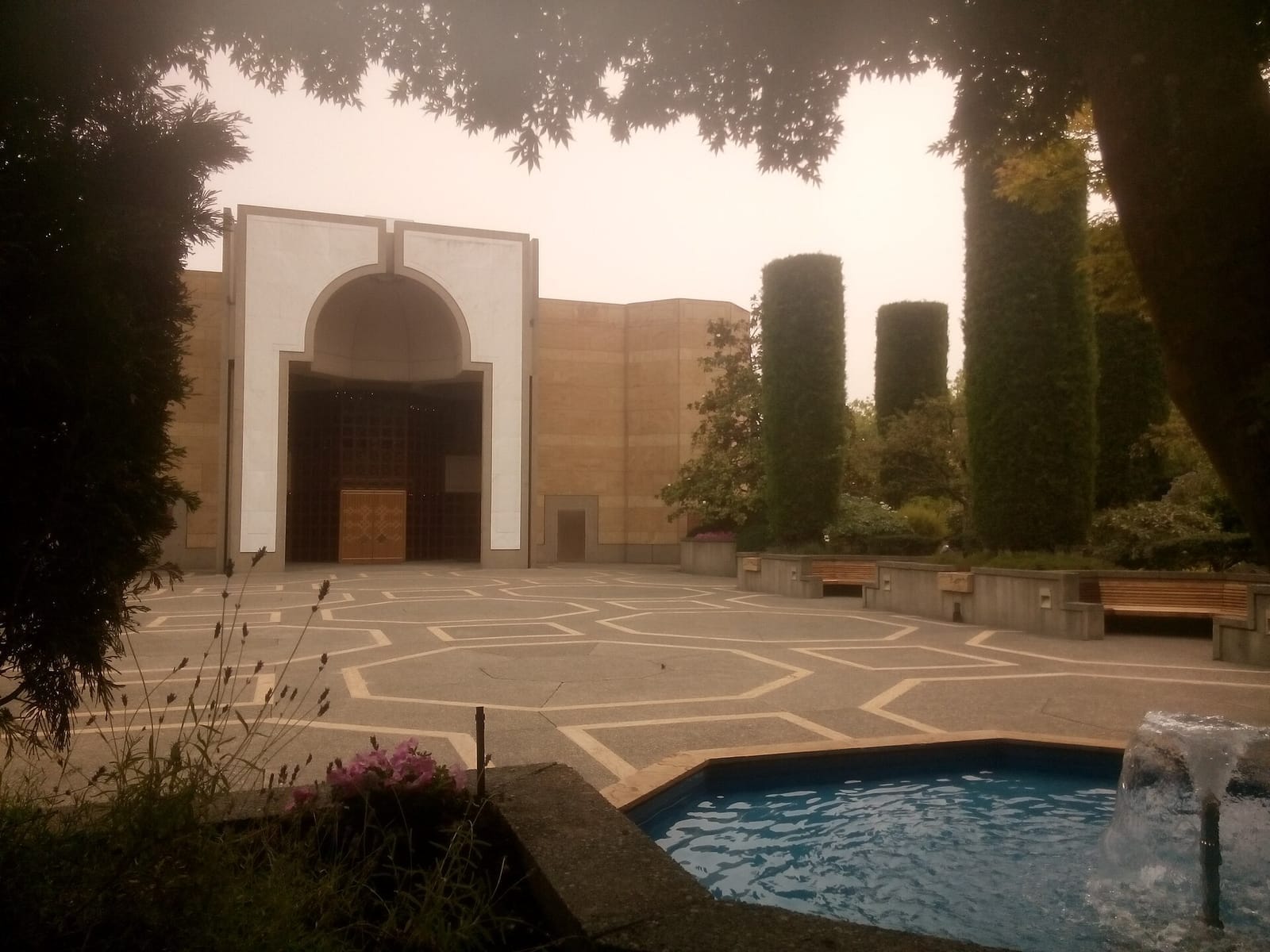
In 1985, the Aga Khan and the Prime Minister opened a building shaped like a prayer. Bruno Freschi designed it around a single geometric form — the octagon, "where the centre is everywhere, and everyone is in the centre." Thirteen years earlier, President Idi Amin had expelled the community that would fill it.
A phone call in August
In August 1972, Idi Amin gave Uganda's Asian population ninety days to leave the country. Roughly 80,000 people. Ismaili Muslims made up about thirty per cent of that number. Their spiritual leader, Aga Khan IV, picked up the phone and called Pierre Trudeau.
More than 7,000 Ismailis resettled in Canada over the next year. Many ended up in Greater Vancouver. They brought families, professional skills, whatever they could carry. They did not bring buildings. Buildings would have to come later.
Later turned out to be thirteen years.
Trail, BC to the world
Bruno Freschi was born on April 18, 1937, in Trail, a smelter town in the West Kootenay where the air smelled like zinc and ambition pointed elsewhere. He studied architecture at UBC, graduated in 1961, and spent time working with Arthur Erickson before founding his own firm in 1970. He would go on to design the geodesic dome that became Science World. He would serve as chief architect of Expo 86. In 1985, the same year the Ismaili Centre opened, he was made an Officer of the Order of Canada.
But the Centre came first in the sequence of commissions that defined his career. And the Centre started with a shape.
Eight sides
The octagon. Freschi built the entire site around it. "Geometry governs the entire site," he said. "It is symbolized in the octagon, the 'mythical squaring of the circle.' The Octagon is omni-directional. All axial relationships are equal: The centre is everywhere, and everyone is in the centre."
That last phrase does a lot of architectural work. A circle has a centre that everything radiates from. A square has corners that create hierarchy — the person nearest the corner is farthest from the middle. An octagon splits the difference. Eight equal sides. No front, no back. Stand anywhere inside one and you are roughly the same distance from every wall.
For a prayer hall serving a community that had been scattered across continents by political violence, the geometry carried weight beyond aesthetics.
What the building is made of
The structure is cast concrete. The exterior is clad in sandstone. The entrance is marble. Five shallow copper domes sit on top — Turkish-style, not the high onion domes of Mughal mosques. The amber glass windows are one inch thick, with Arabic calligraphy fired onto both surfaces. Freschi noted that the layered inscription "visually vibrates when seen at an angle." Light passes through twice-written words.
Inside, a courtyard garden holds a fountain. You can hear it from the entrance — water on tile, the kind of sound that makes a hallway feel cooler than it is. The basement contains offices and classrooms. Two upper floors house a double-height prayer hall and a multi-purpose hall. The prayer hall faces Mecca. The multi-purpose hall faces the parking lot, which on any given weekend might hold a wedding reception, an education seminar, or a community health screening. Sometimes all three, separated by a thin wall and good scheduling.
Freschi described the tension he was trying to hold: "The architecture must be simultaneously an iconic, symbolic form, complete and unequivocal yet it must transform and become ephemeral." Permanent materials — concrete, sandstone, marble — carrying a building that was supposed to feel like it could dissolve into light. He called the material choices "symbols of a 'timeless' foundation for the Ismaili community."
Whether he achieved timelessness is a question for the next century. He achieved durability. The building has been standing for forty-one years.
Two ceremonies
The foundation ceremony took place on July 26, 1982. Aga Khan IV laid the stone and said: "This is the first project to be launched during this Jubilee year and it is very important that it is a place of worship."
Three years of construction followed. Whichever Burnaby residents drove past the site on Canada Way during that period watched an octagon rise from a vacant lot, which is the kind of thing that happens slowly enough to stop noticing.
On August 23, 1985, Prime Minister Brian Mulroney stood beside the Aga Khan at the opening. It was the Silver Jubilee — twenty-five years since the Aga Khan had assumed the Imamat. Mulroney cut a ribbon. The Aga Khan spoke. "It is my hope, a very deep hope, that it will become a symbol of a growing understanding in the West of the real meaning of Islam."
That sentence has aged in complicated ways. The hope remains. The understanding is still growing, forty-one years on, at a pace that probably disappoints the speaker.
First in North America
Burnaby's Ismaili Centre was the first in North America. Only London's opened in the same year, 1985. Since then, five more have been built: Lisbon in 1998, Dubai in 2008, Dushanbe in 2009, Toronto in 2014, and Houston most recently. Seven worldwide.
The Aga Khan has called these centres "ambassadorial buildings — representatives of the Ismaili community and all its aspirations." Embassies for a nation without borders. The analogy is precise. Embassies represent a state to a host country. Ismaili Centres represent a community to a host city. The difference is that embassies have diplomatic immunity and Ismaili Centres have to follow Burnaby's parking bylaws.
The neighbourhood doesn't notice
Drive east on Canada Way from Boundary Road and you pass a Chevron station, a strip mall, a dental office, a couple of low-rise apartment buildings. Then the sandstone appears. The copper domes. The landscaped grounds. It looks like it was dropped from a different postal code — and on a Tuesday afternoon in May, with the sprinklers going and nobody on the steps, it has the quiet of a place that knows its own schedule and doesn't need yours.
In 2010, on its twenty-fifth anniversary, the Globe and Mail called the Ismaili Centre one of British Columbia's "best-kept architectural secrets." The phrase is telling. A secret implies something hidden. The building sits on a major arterial road. Tens of thousands of cars pass it daily. Most of them have never looked up at the copper domes.
Pluralism as architecture
The Aga Khan has spent decades talking about pluralism. "Pluralism begins with difference," he has said, "and it does not require us to leave behind our cherished identities." Freschi's octagon makes the same argument in concrete and sandstone. The shape has no preferred orientation. Every side is equal. You can enter from any direction and arrive at the same centre.
Thirteen years passed between a dictator's expulsion order and a foundation stone in Burnaby. Three more years between the stone and the opening. The community that Idi Amin tried to erase built an octagon on Canada Way and filled it with prayer, classrooms, weddings, and parking disputes.
The calligraphy on the amber glass vibrates when you see it at an angle. You have to be standing in the right place. You have to be looking.
Editor & Publisher
Artom Butenko
Founder and editor of 8 Pages Burnaby. Writes the fact-dense, archival pieces — origins, infrastructure, and the documents that explain how the city works.
More from May 2026
Full issue →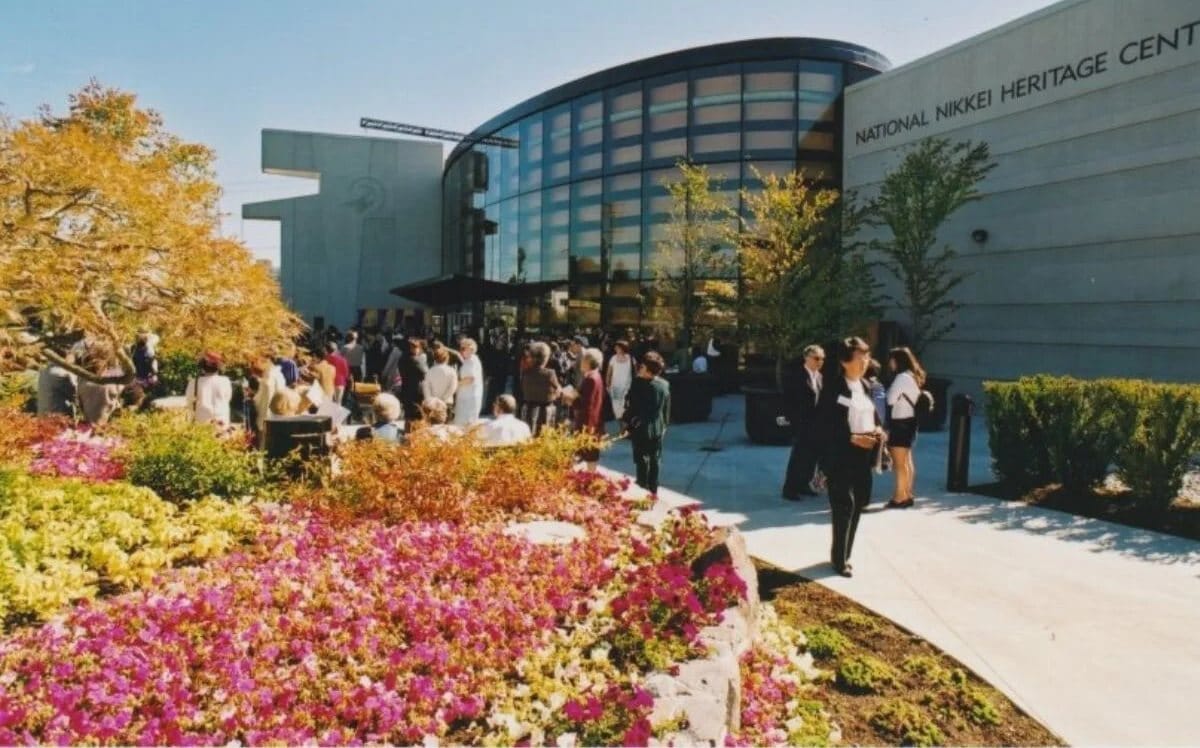
Nikkei Place: The Garden Built for Healing
The architect who designed the building was interned as a child. The land was purchased with redress money. The opening date was chosen to mark the anniversary of an apology. Inside are 670 recorded voices and 52,500 photographs from a community that lost everything and built this anyway.
Artom Butenko · 9 min read

Ian James Corlett: The Man Who Made a Cartoon About His Street
He voiced Goku, left over a pay dispute, and went home to Burnaby to create a cartoon about growing up on Royal Oak Avenue. The piano store became a keyboard shop. The house became a drawing. The city became sixty-five episodes of a show that YTV aired for three years and then forgot.
Artom Butenko · 5 min read