What Remains of Expo 86 in Burnaby
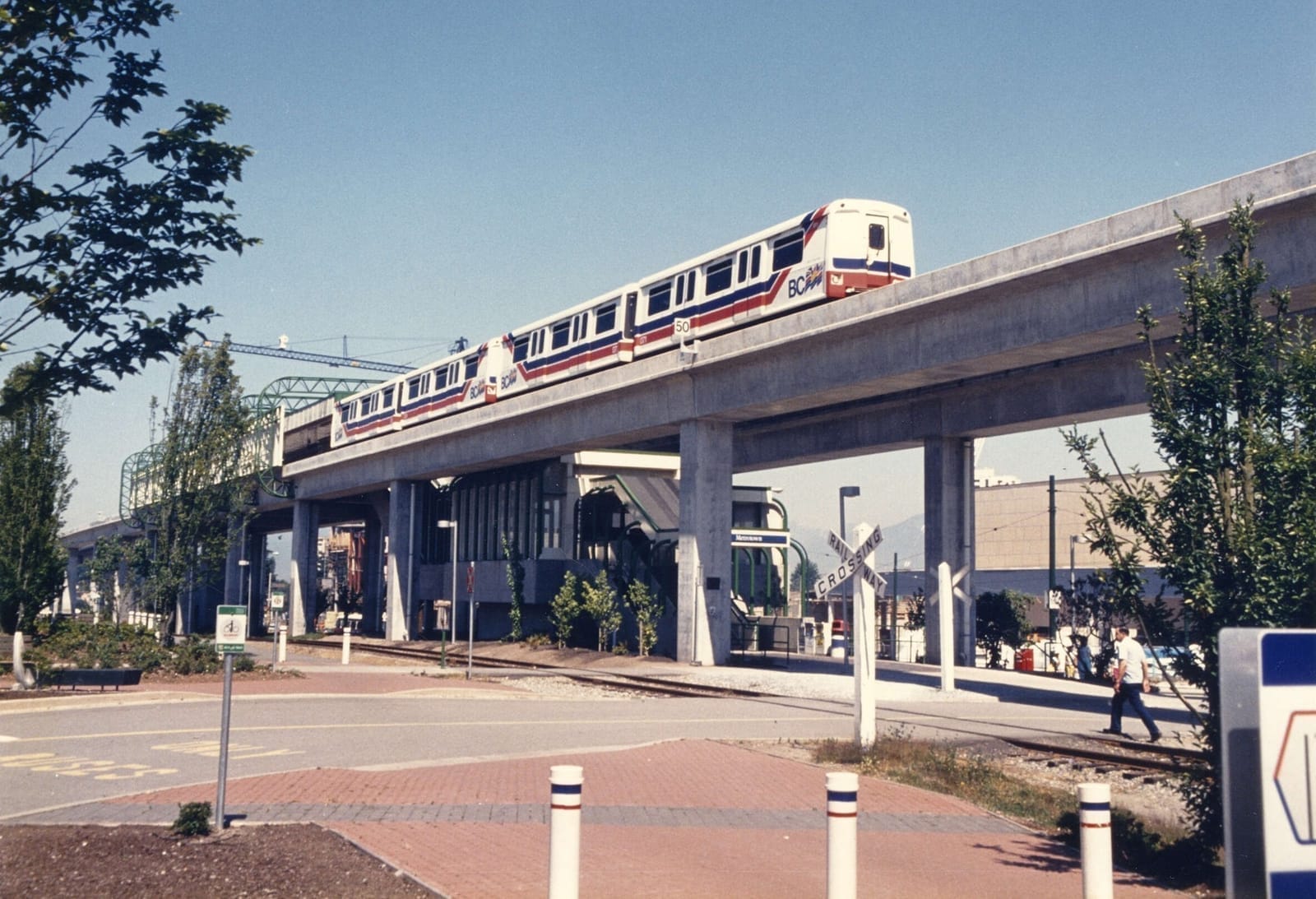
If you stand on the platform at Metrotown Station during rush hour, you're surrounded by thousands of people. Fifty thousand passengers pass through here daily, more than the population of some cities. The escalators, among the tallest in the SkyTrain system, lift and lower an endless stream. Glass elevators glide up and down. In 2025, the first public washrooms in the entire SkyTrain network finally opened here, an event nearly forty years in the making.
But look closer, and beneath all the gleaming upgrades, you can make out the contours of something older. The rounded canopy forms above the platform. The distinctive silhouette of the concrete supports. This isn't contemporary design, this is 1985. This is Expo 86.
The World's Fair that ran in Vancouver from May to October 1986 drew 22 million visitors. They came to see pavilions, hear concerts, glimpse the future. Most of them never set foot in Burnaby. But the infrastructure built to transport them, the elevated guideways, the automated trains, the cycling path, became what permanently changed the neighbouring city.
The Ghost of an Old Railway
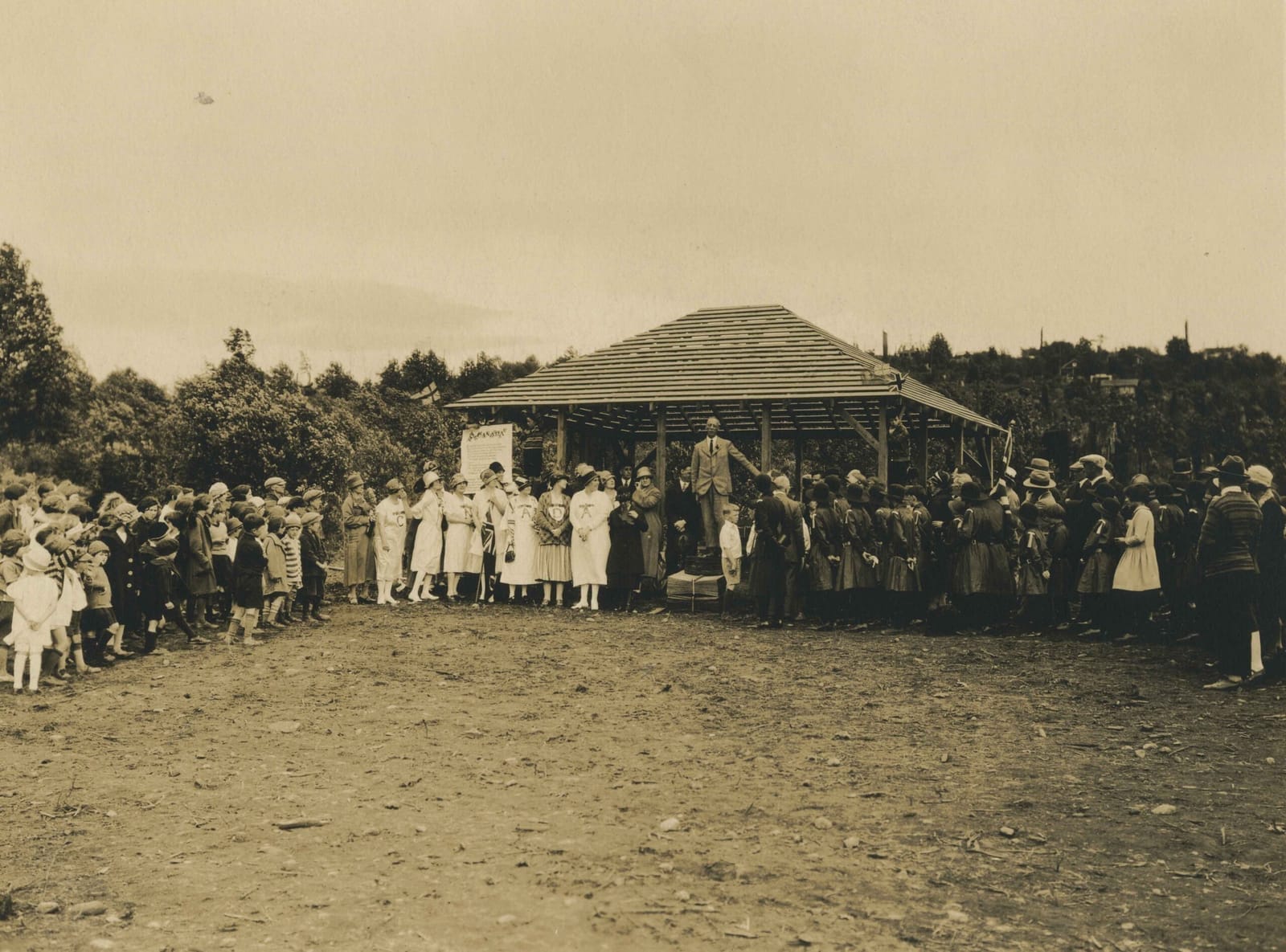
The story begin in 1891, almost a century earlier. The BC Electric Railway launched an interurban tramway connecting Vancouver to New Westminster through Central Park. The line ran through what was then countryside: farms, forests, scattered settlements. The trams ran here for over sixty years, until passenger service ended on October 23, 1953.
The rails were torn up. The stations demolished. But the right-of-way (that narrow corridor of land reserved for transit) remained. It grew over with grass and brush, but legally still belonged to the transit authorities. For thirty years, this ghost corridor waited.
When the British Columbia government decided in the early 1980s to build a rapid transit system for Expo 86, the old interurban route proved the perfect solution. No need to buy land from private owners, demolish buildings, or conduct endless negotiations. The corridor already existed, they just needed to raise concrete guideways above it.
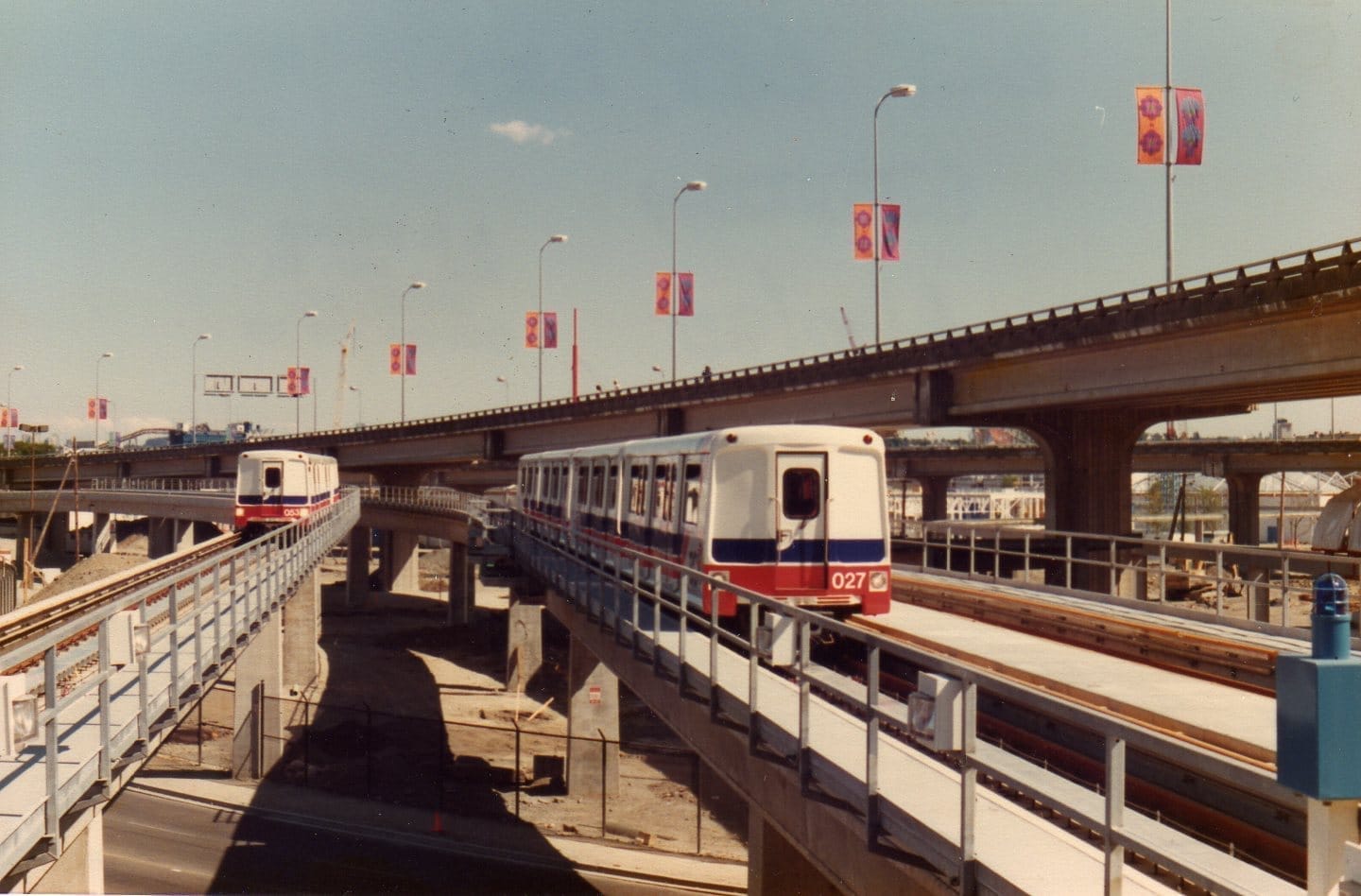
On March 1, 1982, Premier Bill Bennett launched construction. The technology came from Ontario, automated trains on linear induction motors, capable of running without drivers. North America had never seen anything like it.
Four Stations That Changed Everything
The City of Burnaby Archives holds photographs from November 27, 1983. They show construction crews erecting the guideway at the intersection of Jubilee Avenue and Imperial Street. This is the exact spot where the BC Electric interurban station once stood. History was repeating itself, only now, fifteen metres above the ground.
Four Burnaby stations opened on December 11, 1985, five months before the fair began: Patterson, Metrotown, Royal Oak, and Edmonds. They were designed by the Austrian architectural firm Architektengruppe U-Bahn—the same firm that created Vienna's modern U-Bahn stations. Hence the distinctive rounded forms, the human scale, the minimalist modernism. Canadian firm Allen Parker & Associates handled the local adaptation.
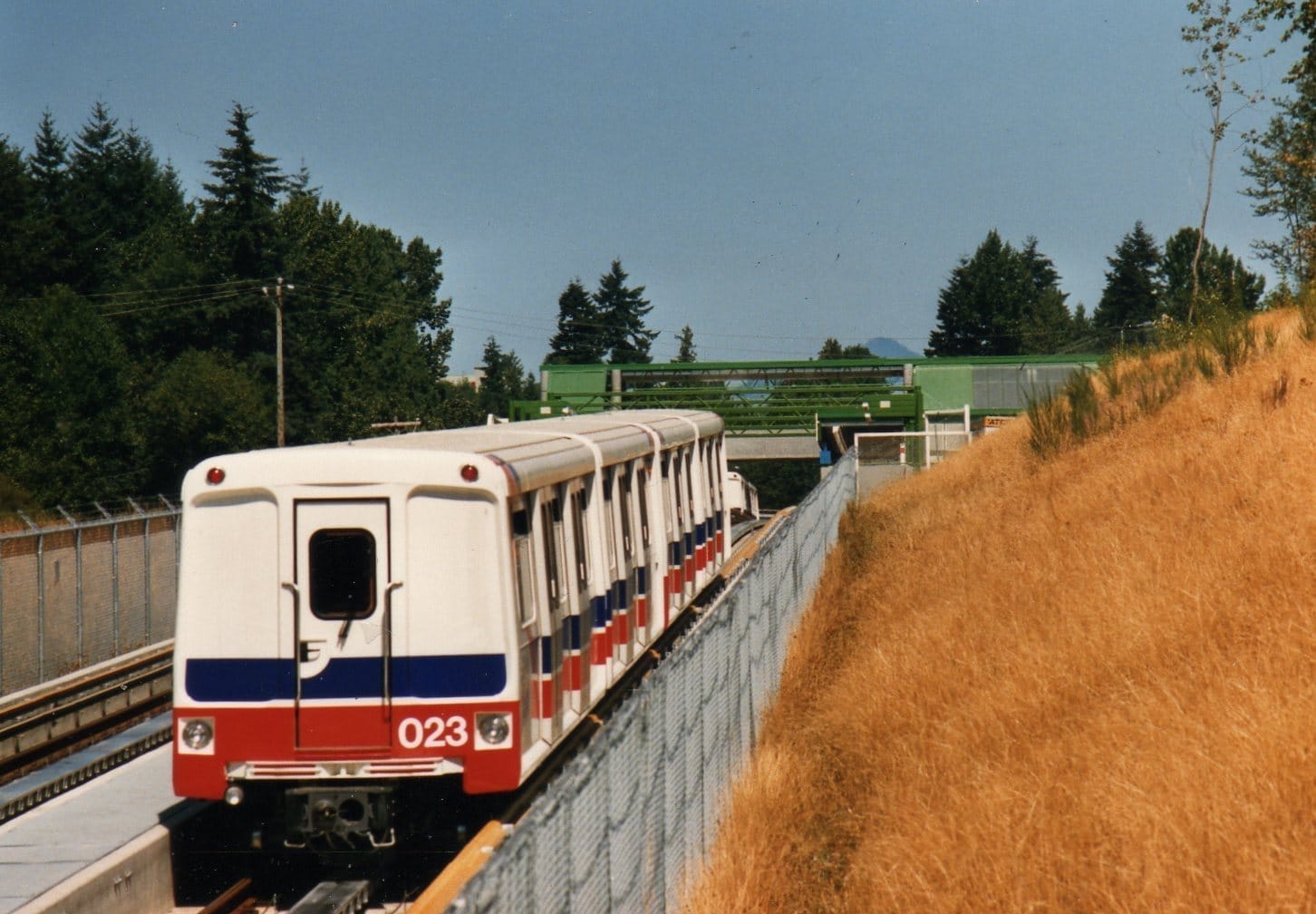
The opening wasn't flawless. Some escalators failed. One train sat at Stadium-Chinatown Station for fifteen minutes when its doors jammed. But within the first three weeks, a million passengers had used the system. Daily ridership reached 40,000 to 50,000, climbing to 70,000 on Saturdays. The forecast had been 40,000. The future proved more popular than expected.
A Princess on the Platform
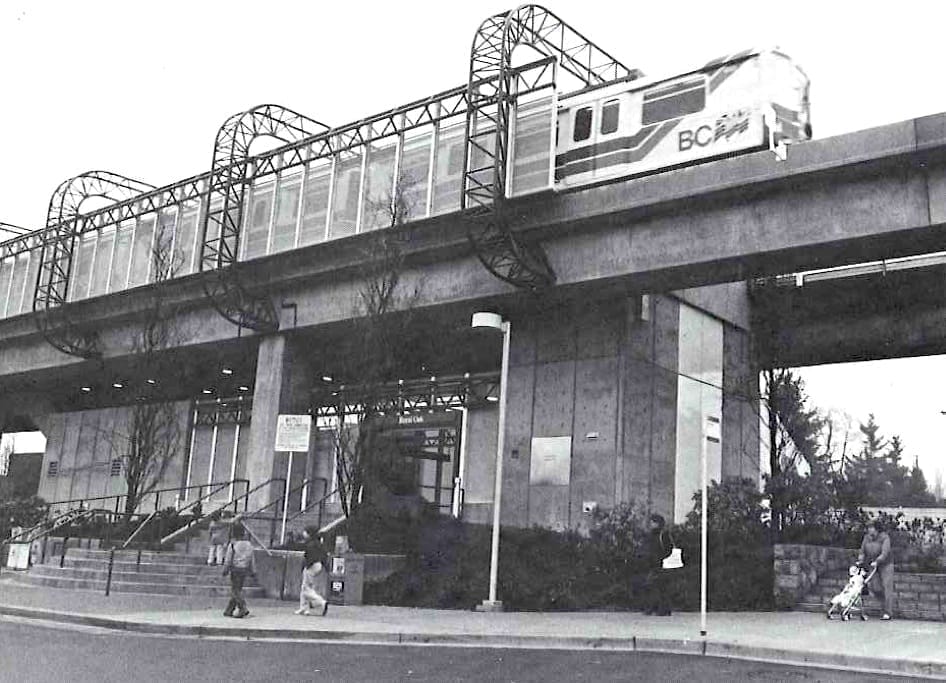
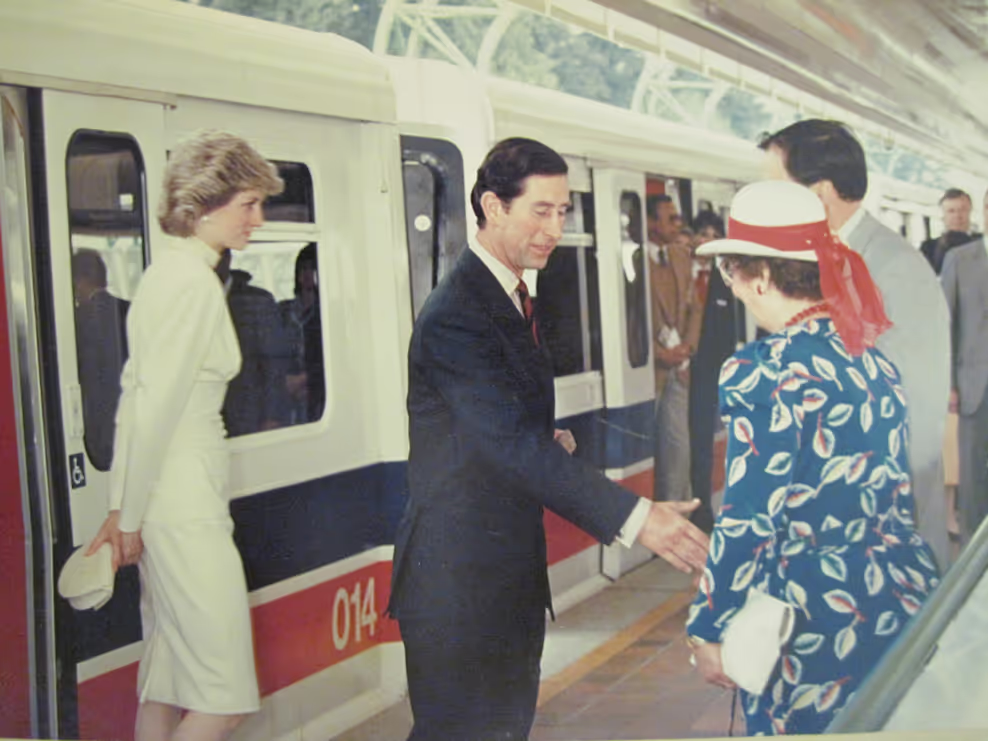
On May 6, 1986, something happened at Patterson Station that made newspapers around the world. Princess Diana and Prince Charles, in Vancouver for the opening of Expo 86, decided to ride SkyTrain from downtown to Burnaby. They disembarked right here, at the modest station on the eastern edge of Central Park.
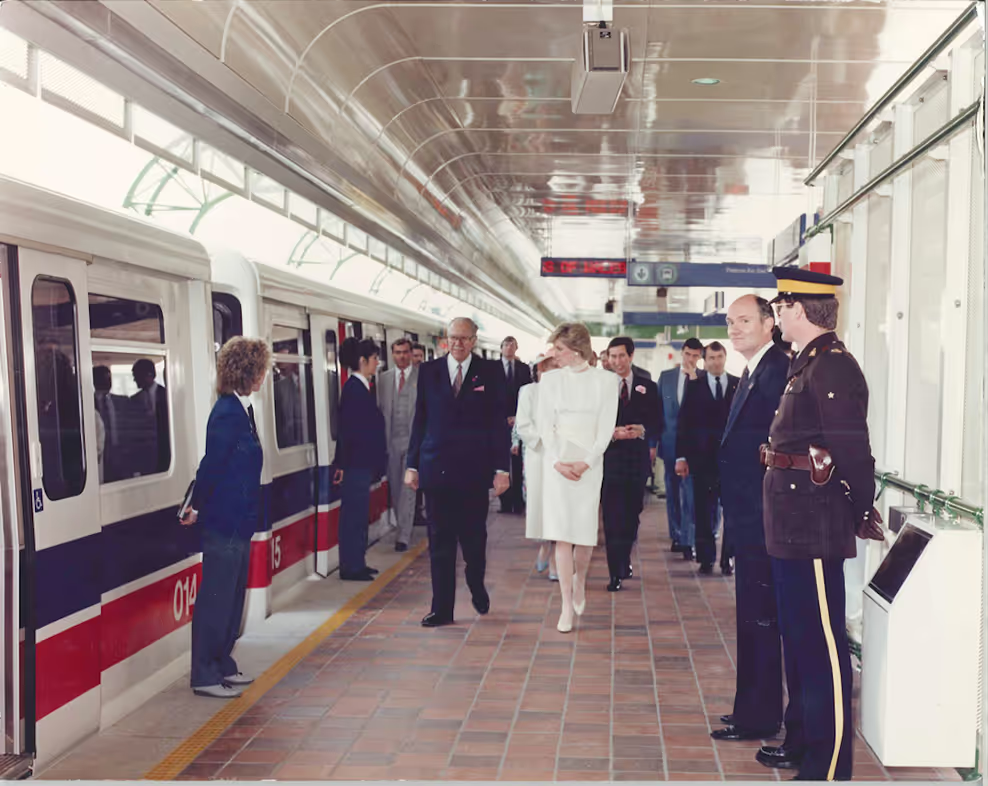
The station is named for pioneer Dugald Campbell Patterson, who built the original interurban stop in the 1890s. That May day in 1986, history came full circle: British royalty christened the spot where, nearly a century earlier, the first tram had stopped.
Patterson remains closest to its original 1985 appearance. The Vienna-style rounded forms are still visible. The scale is still human. If you want to feel what the system looked like in its opening year, come here.
Metrotown: From Ford Factory to the System's Second-Busiest Station
Metrotown tells a different story entirely.
Before SkyTrain, this was industrial land. In 1938, a Ford Motor Company assembly plant opened here. In 1946, Kelly-Douglas Company food manufacturing. In 1954, a Simpsons-Sears catalogue distribution centre. Burnaby had designated the area as the "Metrotown development zone" back in July 1974, but real construction never materialized. Too far from everything, too inconvenient to reach.
SkyTrain changed the equation. Metrotown Centre mall broke ground in August 1985, just months before the station opened. It was finished by fall 1986. Station Square followed in 1988. Then Eaton Centre, now Metropolis at Metrotown, the third-largest enclosed mall in Canada, in 1989. Crystal Mall came in 1999–2000.
The numbers are striking. Population within 500 metres of SkyTrain stations grew 37% between 1991 and 2001, compared to a 24% regional average. Metrotown's population increased 44% over the same period, reaching 25,540 by 2006. The transit mode share in the census tract immediately south of the station hit 53%, the highest in Metro Vancouver.
Private investment within a 10–15 minute walk of SkyTrain stations exceeded $5 billion. Total transit-oriented development along the Expo Line surpassed $9 billion within five years of the 1986 opening.
Today's Metrotown Station bears almost no resemblance to the 1985 original. Between 2015 and 2018, a $55.5 million upgrade doubled the station's size, three new entrances, eight escalators, three high-speed glass elevators. The project won the Deputy Minister's Award of Excellence and a gold award from the Vancouver Regional Construction Association. But beneath all those layers of modernization lies the same 1985 concrete guideway. The same ghost corridor of the interurban.
The Trains That Won't Retire
Perhaps nothing illustrates the staying power of Expo 86's legacy better than the trains themselves.
The 150 Mark I cars, built at the UTDC plant in Kingston, Ontario between 1984 and 1986, still run on the Expo Line. Each has logged more than 4 million kilometres. That's like flying to the moon and back ten times.
The original cars had carpeted floors (removed in mid-1992) and passenger-activated door buttons (removed 1989–1991). Many have been repainted in TransLink's corporate blue-grey colours, but the engineering remains 1980s technology.
In 2013, 114 original cars underwent major refurbishment, extending their service life to 2026–2027. TransLink is now exploring ways to give these trains a second life, possibly as stationary installations along BC Parkway. Imagine: a SkyTrain car converted into a café or community space, standing on the very ground where interurban trams once ran.
A Cycling Path Ahead of Its Time
When BC Transit built the Expo Line, they included something unusual for 1985: a 26-kilometre multi-use path running parallel to the guideway from Surrey City Centre through New Westminster and Burnaby to Vancouver.
Cycling paths were "an up-and-coming concept" back then, few understood how to design them. BC Parkway became Metro Vancouver's first recreational cycling route. The Burnaby segment (roughly 3.3 kilometres between Boundary Road and Royal Oak Station) passes through Central Park, by Patterson, through the Metrotown commercial district, past the Bonsor Park complex, and on to Royal Oak.
The route follows the exact corridor of the 1891 interurban. Three layers of transit history, tram, SkyTrain, bike path, lie atop one another like geological strata.
Today, BC Parkway shows its age. TransLink describes the infrastructure as "reaching the end of its useful life", narrow asphalt, minimal lighting, almost no street furniture. But Burnaby is investing in transformation. Since 2021, the city has installed programmable LED lighting on the underside of the guideway between Patterson and Edmonds stations, 178 concrete pillars over 5 kilometres.
The "Parkway Alive!" project envisions transforming the corridor into a linear park with public art, including works by Indigenous artists near Bonsor and Royal Oak. Plans call for restoring the historic 1913 Central Park wrought-iron arch and possibly integrating a fragment of brick wall from the old interurban station.
The Nerve Centre in Edmonds
Next to Edmonds Station, at 6800 14th Avenue, sits a building most SkyTrain passengers don't even know exists. This is the SkyTrain Operations and Maintenance Centre (OMC1), operational since 1985.
From here, all train movements on the Expo and Millennium lines are controlled. This is where cars are parked and serviced. Where decisions are made during breakdowns and emergencies. For nearly forty years, this building has been the system's brain.
OMC1 is now being replaced. A new $327-million control centre is under construction because the 1980s infrastructure can't handle the expanded network. But the old building will remain, a monument to an era when driverless automated transit seemed like science fiction.
Memorial Markers Along the Line
Since 1993, the Burnaby Community Heritage Commission has been installing bronze plaques along the Expo Line, tracing the footsteps of the 1891 interurban beneath.
At Metrotown Station's Telford Avenue entrance, two plaques are mounted on guideway supports. One is a City of Burnaby Heritage Site plaque acknowledging the history of the BC Electric Railway's Central Park Line. The other commemorates the start of work on the Burnaby portion on August 26, 1983.
East of Royal Oak Station stands a plaque dedicated to the memory of construction workers killed during SkyTrain's construction between 1983 and 1985. A sombre reminder of the human cost of building the future.
The 1914 Central Park Gates on Kingsway mark the ceremonial entrance to the 90-hectare urban park founded in 1891. Two massive stone pillars, roughly 7.5 metres high, support a historic iron arch with the words "Central Park." They were designed by Robert Lyon, one of British Columbia's most accomplished early architects. SkyTrain passes within sight of these gates, a physical link between the interurban era and the age of automated transit.
Infrastructure as Permanent Exhibition
The 22 million visitors to Expo 86 came to see pavilions, performances, the future. Most never visited Burnaby. But the infrastructure built to transport them, the guideways, the automated trains, the bike path, the maintenance centre, became a permanent exhibition of what a suburban municipality could become.
Metrotown transformed from industrial backwater into the region's densest transit-oriented development. BC Parkway, built before cycling infrastructure was standard practice, established a template for active transportation corridors. The original Mark I trains, approaching 4 million kilometres each, proved that automated transit technology could run for four decades with proper maintenance.
The fair's theme was "Transportation and Communication: World in Motion — World in Touch." In Burnaby, that theme never stopped moving.
What remains of Expo 86 in Burnaby isn't a monument or a museum. It's working infrastructure: upgraded, expanded, woven into daily life. Every morning, when you ride the escalator at Metrotown Station or pass Patterson in a driverless train, you're using the legacy of a world's fair that ended nearly forty years ago.
The future they promised in 1986 became the present. And it's still running.
Editor & Publisher
Artom Butenko
Founder and editor of 8 Pages Burnaby. Writes the fact-dense, archival pieces — origins, infrastructure, and the documents that explain how the city works.
More from February 2026
Full issue →
Burnaby's basement rebellion: How suburban teenagers built Vancouver's punk revolution
Canada's most influential punk scene wasn't born in gritty urban streets—it emerged from the split-level basements of Burnaby Mountain. How childhood friendships in a bedroom community produced D.O.A., The Subhumans, and the country's first indoor skatepark.
Artom Butenko · 17 min read
The Butterfly Painter of Capitol Hill: a story of Jack Shadbolt
For 48 years, Canada's most celebrated modern painter worked from a skylit studio on a Burnaby mountainside, transforming wartime trauma into butterflies and leaving behind the community arts centre that bears his name.
Brenda · 10 min read
Hidden Green: the Stories Buried Beneath Burnaby Parks
A beaver pond that became a real estate joke. A garbage dump where children now dig for treasure. A cenotaph built by the veteran it honours. Four Burnaby parks hiding stories that never made it onto plaques.
Ilarion Bohatyrov · 11 min read