Digney Speedway: The Racetrack Under Metrotown
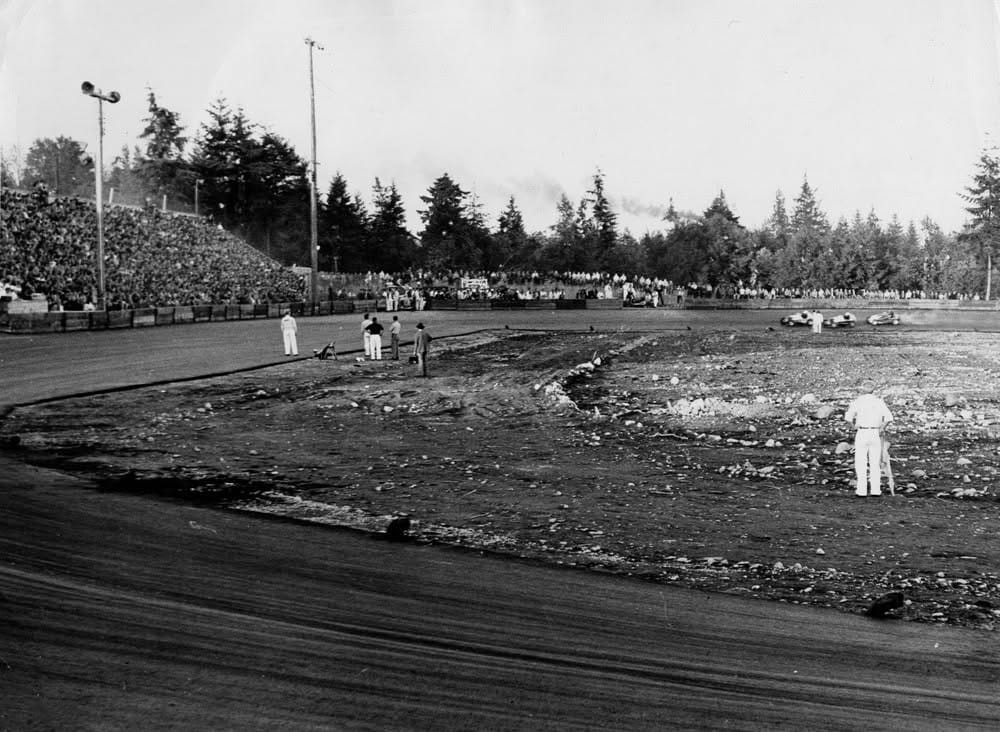
On July 8, 1948, Andy Digney opened a quarter-mile oval with grandstands for 4,500. Men bought 1930s cars, welded the doors shut, and raced. By 1958 the track was gone. Towers stand on the site now.
Deck: On July 8, 1948, Andy Digney opened a quarter-mile oval with grandstands for 4,500 spectators. Local men bought 1930s cars, ripped out all the glass, welded the doors shut, and raced. By 1958, the track was gone. Residential towers stand on the site now. Andy's grandson digitized the home movies in 2012.
Andrew Charles Digney was born in London, England, on July 27, 1886. He came to Canada in 1905 with his brother, settling first in Raymore, Saskatchewan — a town so small it barely registered on the rail maps. He married Alice Swan in 1914. Their son Ernest, who everyone called Dig, was born in 1920. The family moved to Burnaby in 1935, and Andy started building things.
The first thing was a movie theatre.
The Oak
The Oak Theatre opened at 5000 Kingsway — the corner of Marlborough and Kingsway — on August 4, 1937. Andy named it "because the mighty oak was strong and stood forever." CKWX radio's Billie Browne served as master of ceremonies for opening night. Three hundred and fifty seats. Valet parking, which in 1937 Burnaby was a statement of ambition.
The building was ultra-modern white stucco with floodlights and a pink-and-green neon marquee. Inside: a mirrored ceiling, a working fireplace, an aquarium, and a colour scheme of orchid, royal blue, silver, and black. It was the kind of theatre a man builds when he wants a neighbourhood to take itself seriously.
Andy ran the Oak for seven years. In 1944, he had a severe heart attack. He sold to Odeon Theatres in 1945. They kept it open until 1968. The building is gone now.
But by 1945, Andy had already moved on to his next idea. Somebody had asked him about a racetrack.
A quarter-mile oval near Irmin Street
The BC Midget Auto Racing Association came to Andy around 1946, looking for someone with land and nerve to build a racing venue. He purchased ten acres near Irmin Street and MacPherson Avenue — land that sat in what was then the undeveloped middle of Burnaby, south of Kingsway, nowhere near anything that mattered.
Gordon Reelie laid out the dimensions. Reelie had fallen in love with motorsport as a boy in North Burnaby, lying in his family's backyard listening to engines at Hastings Park. He patterned the Digney track after Seattle's Aurora Stadium — a quarter-mile paved oval, tight enough that the cars were always in view. He would later lay out False Creek Speedway using the same template.
Reelie tried driving once. He won. He promptly retired from competition and spent the rest of his career running things from the sidelines. A wise man. He became president of the BCMRA, sent cars as far south as Ascot Speedway in Los Angeles, and was inducted into the Canadian Motorsport Hall of Fame before his death in 1994.
The Digney Speedway opened on July 8, 1948. Grandstands for 4,500 spectators. The first races were midget cars — small, purpose-built open-wheel machines.
The jalopy breakthrough
Midget car racing was expensive. By 1949, attendance had started to drop. Andy tried roadsters — bigger, faster, more dramatic. Too expensive for local drivers. The track needed something cheaper.
In 1951, someone figured it out. Jalopy racing. The rules were simple: buy a 1930s Ford Model A or Model B from a junkyard. Rip out all the glass. Weld the doors shut. Gut the interior. Replace what's broken with whatever you can find. Race.
The economics worked. A running Model A cost almost nothing. Parts came from the same junkyards. The smell on race nights was exhaust and hot brake dust and something sweet from the concession stand, all of it hanging in the summer air over those ten acres. By early 1952, more than forty cars were showing up on race days. On the biggest days, two hundred cars arrived to qualify for a sixteen-car main event. Two hundred for sixteen spots. That's how badly people wanted to drive in circles at high speed on a Saturday.
Mel Keen drove at Digney from 1952 to 1966. Hank Butcher, Reelie's driver, came up from San Leandro, California, won seventy-nine career races, and landed in the National Midget Auto Racing Hall of Fame. George Hollinger was born in Montreal in 1930, served in the Navy during the war, motorcycled across the continent afterward, and moved to Burnaby in 1952 specifically because of the Digney Speedway. He didn't come for a job or a girl or cheap rent. He came for the track. He built championship engines. Don Smith towed his stock car to the track behind a Model A Ford. Larry McBride ran car number eight.
These were not wealthy men. They were mechanics, labourers, small-business owners — people who could weld a door shut and true a crankshaft but could not have afforded a real racing team. Digney gave them a place to do the thing they wanted to do.
Living above the restrooms
Ernest "Dig" Digney, Andy's son, returned to Burnaby in 1953 with his wife Joyce and their sons Paul and Bruce. They moved into a 550-square-foot apartment directly above the speedway's restrooms.
The family lived at the track. Not near the track. At it. The boys grew up with the sound of engines below them and the smell of racing fuel drifting up through the floor. Bruce would later say it was a good childhood, which is the kind of thing people say about unusual upbringings that they actually mean.
The noise complaint
Burnaby City Council received a noise complaint about the speedway on August 9, 1948 — exactly one month and one day after opening. Two hundred cars being gunned through qualifying will do that to a neighbourhood.
The track survived the complaint. It survived ten more years of them. Andy sold his bowling alley in 1956 and retired. The speedway closed in 1958. The reasons were the usual ones: the land was worth more as something else, the neighbourhood had grown up around the track, and a ten-acre oval surrounded by houses was no longer a thing the city was willing to tolerate. The engines went quiet. The grandstands came down.
Andy left on a world tour. He died in England in 1964, back where he'd started.
The home movies
In 2012, Paul Digney — Andy's grandson — digitized eighteen short 8mm films from the family collection. The footage includes the land being cleared for the speedway and the grand opening on July 8, 1948. Grainy, silent, the colour shifted toward orange the way old Kodachrome does. Men in white shirts standing by a fence. Cars throwing dust. A grandstand full of people who are all dead now.
Heritage Burnaby holds the Digney Family fonds: sixty-five records covering the family's life in Burnaby, plus fourteen records specific to the speedway. Andy was inducted as a 2001 Pioneer by the Greater Vancouver Motorsport Pioneers Society.
The ten acres near Irmin and MacPherson are covered in towers and commercial development. Metrotown. The site holds thousands of people who have no reason to know that the ground beneath their parking garage was once a quarter-mile oval where local men raced junkyard Fords for the pure stupid joy of it.
The home movies are the proof. Eighteen films, digitized, filed away. The cars turn left. The crowd stands. The dust settles on everything.
Editor & Publisher
Artom Butenko
Founder and editor of 8 Pages Burnaby. Writes the fact-dense, archival pieces — origins, infrastructure, and the documents that explain how the city works.
More from May 2026
Full issue →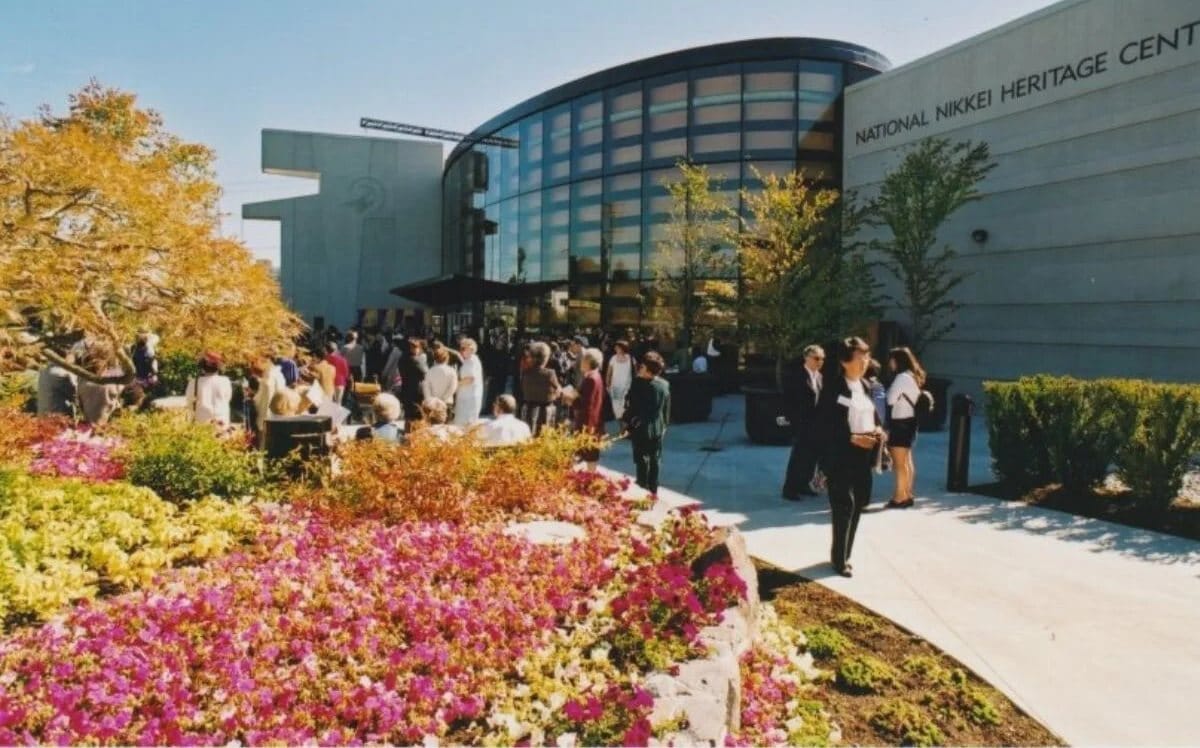
Nikkei Place: The Garden Built for Healing
The architect who designed the building was interned as a child. The land was purchased with redress money. The opening date was chosen to mark the anniversary of an apology. Inside are 670 recorded voices and 52,500 photographs from a community that lost everything and built this anyway.
Artom Butenko · 9 min read
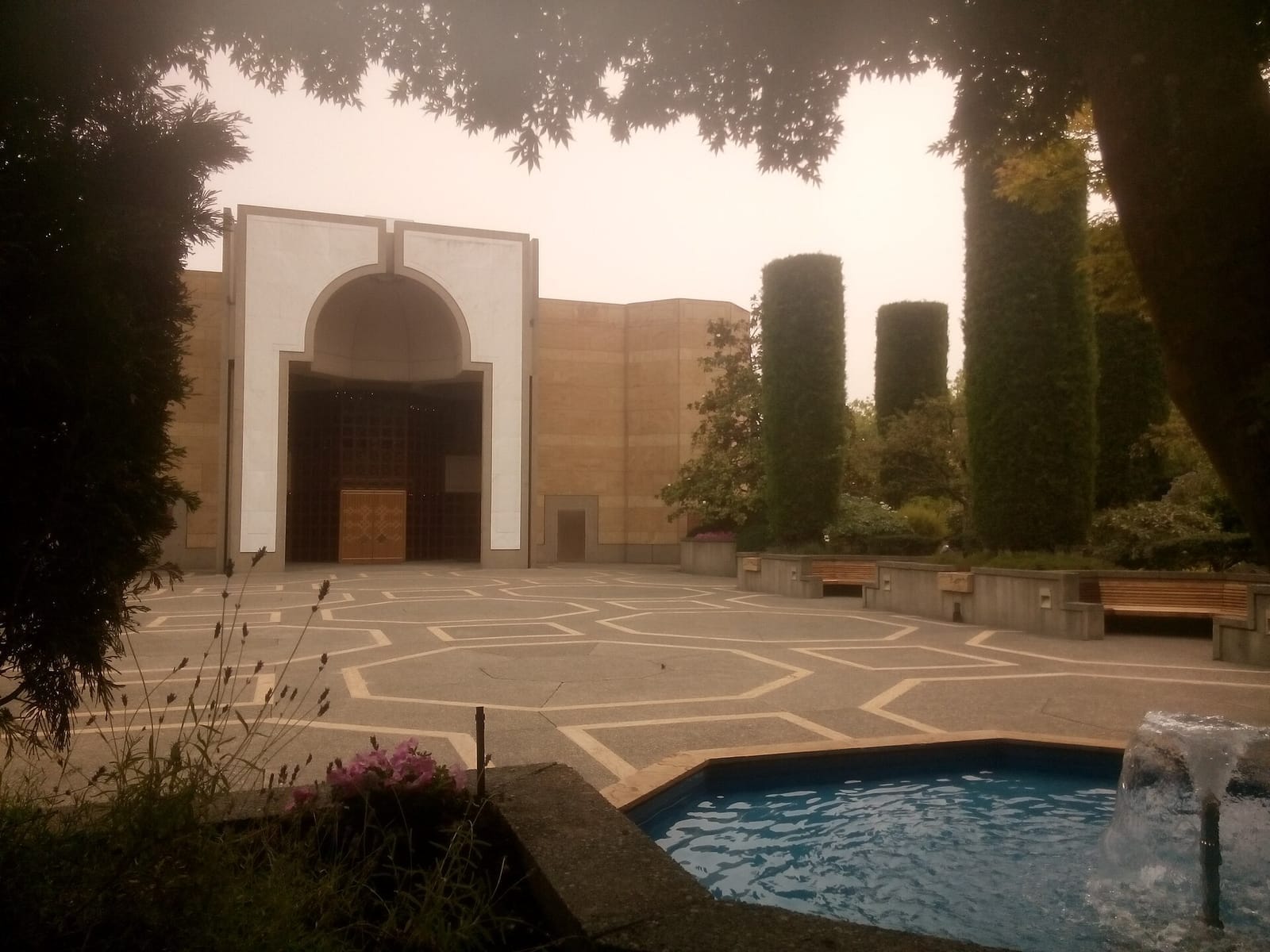
The Octagon on Canada Way: Inside Burnaby's Ismaili Centre
In 1985, the Aga Khan and the Prime Minister opened a building shaped like a prayer. Bruno Freschi designed it around a single geometric form — the octagon, "where the centre is everywhere, and everyone is in the centre." Thirteen years earlier, President Idi Amin had expelled the community that would fill it.
Artom Butenko · 6 min read

Ian James Corlett: The Man Who Made a Cartoon About His Street
He voiced Goku, left over a pay dispute, and went home to Burnaby to create a cartoon about growing up on Royal Oak Avenue. The piano store became a keyboard shop. The house became a drawing. The city became sixty-five episodes of a show that YTV aired for three years and then forgot.
Artom Butenko · 5 min read