The Station That Wandered
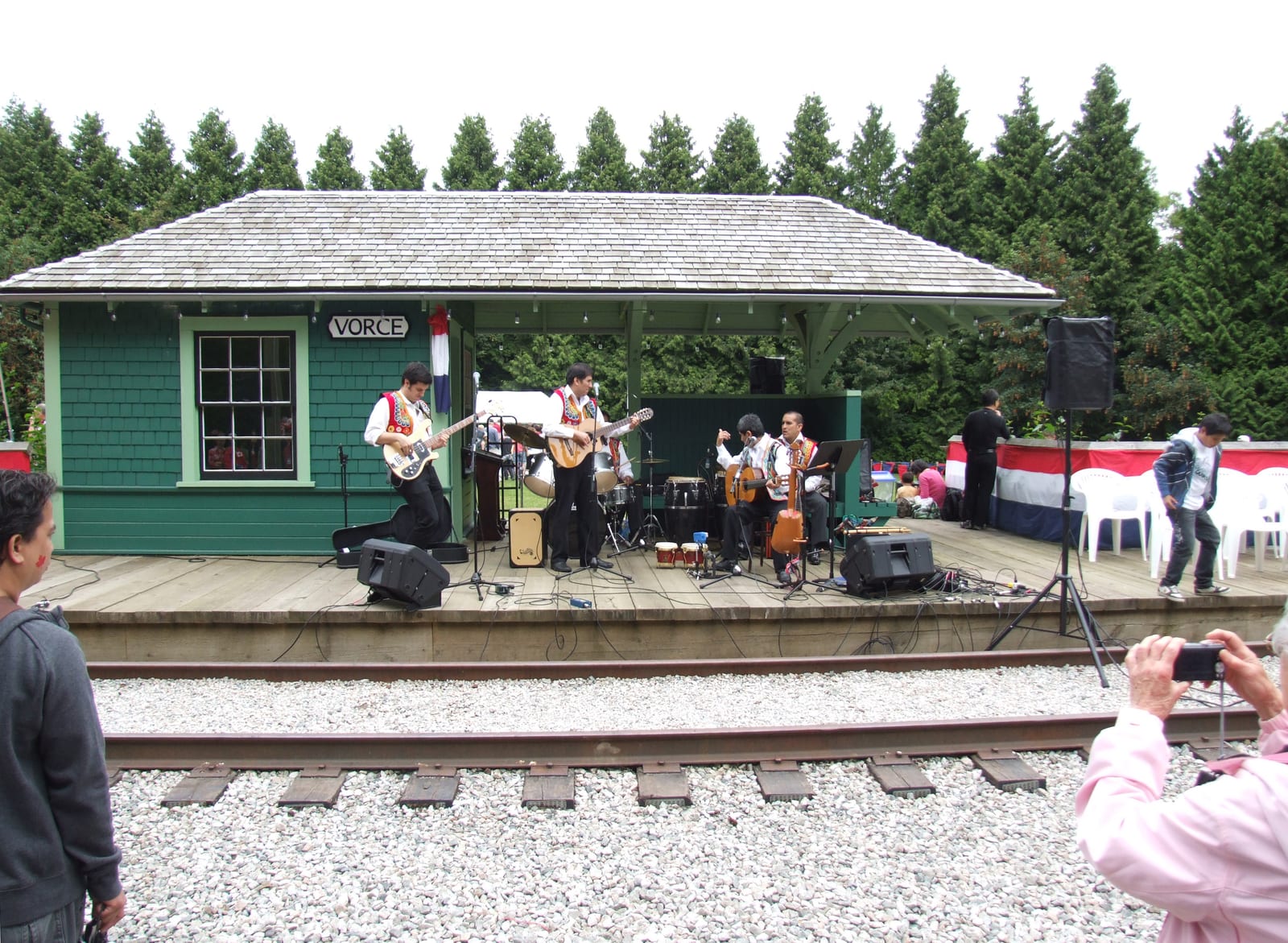
A small wooden tram shelter built in 1911 is the only piece of Burnaby's interurban railway still standing. It has moved twice by truck, and the engineer it was named for has all but vanished from the record.
Picture the foot of Nursery Street in 1911: rails laid through wet bush, a single overhead wire humming, and a small wooden shelter with painted boards and a low roof, just big enough to keep the rain off a few people holding tickets. This was Vorce Station, a passenger stop on the BC Electric Railway's Burnaby Lake Interurban Line. The line opened that same year and ran through the Central Valley, which was then rural ground stretched between New Westminster and Vancouver. The shelter took its name from C.B. Vorce, the BCER's Chief Engineer.
An interurban was an electric railway that carried passengers and freight between towns and across open country, longer-legged than a city streetcar and strung from the same overhead wire. To ride one was to sit in a long wooden car as it swayed and clattered over farmland, the conductor working down the aisle, the smell of ozone and machine oil and damp coats around you. For a few decades this was how the Central Valley moved. People stood at shelters like Vorce Station in the dark and the drizzle, watching for the headlight to swing around the bend. Then the car arrived. Ridership fell. The Burnaby Lake Line, and the wider BCER interurban system that fed it, was gone by the 1950s.
The man in the name
About C.B. Vorce, almost nothing survives. He was Chief Engineer of the BC Electric Railway, and a station carried his name; beyond the title, the trail goes cold. His full name, his birth, his death, the work he actually did for the railway have all dropped out of the record available now.
This was the ordinary fate of a working engineer inside a private utility a century ago. The lines and the timetables and the rolling stock were documented because they earned money. The men who drew them were noted in passing and then forgotten. Vorce surveyed and graded and signed off on the route that built a corner of a young municipality, and what is left of him is a job title and a roof over an old tram platform. The structure is the most durable thing attached to his name, and it says only that he mattered enough, once, for a stop to be called after him.
The station that moved
The shelter outlived the line it served. In 1953 the Lubbock family moved it to their farm, and the reason is plain and practical: it was a sound small building, and someone had a use for it. A waiting room became a farm structure. The rails behind it were torn up; the shelter went on holding tools or feed or shelter from the weather, doing the only thing a small good building knows how to do, which is keep standing while everything around it is carted off.
In 1977 it moved again, this time to the Burnaby Village Museum. In 2008 it was restored to its original appearance. It now stands at 6501 Deer Lake Avenue, beside Deer Lake, well away from the foot of Nursery Street where it began. The lake is old in a way the shelter and the city are not, the water flat and grey on a low morning. Against that kind of time, a building that has stood for a little over a century is almost new, and yet it has already outlasted the entire network it was built to serve.
The City of Burnaby's Statement of Significance, recorded in the Canadian Register of Historic Places under id 2695, names it the last remaining interurban station in Burnaby. It is also one of the few BCER interurban structures left standing anywhere in Greater Vancouver. Across the line in Surrey, Sullivan Station, built in 1909, is another of the rare survivors. The list is short.
What the shelter holds
A whole transport network ran through this valley and then vanished. The rails were lifted, the wires came down, the right-of-way was built over or grown back into bush. Of all of it, the piece that lasted is the smallest: a roof and four walls where people once stood with their tickets, waiting for a tram that stopped coming.
The Lubbock family kept it because it was useful. The museum kept it because it was the last of its kind. Both reasons are true. Neither has much to do with C.B. Vorce, whose name is still over the door. At the museum the shelter sits on the bare ground, no track in front of it and no wire overhead, the same painted boards a passenger leaned against in 1911. It has been moved more times than most of the people who used it ever rode the line, and it is still standing, in the morning quiet by the lake, with a stranger's name above the entrance.
Editor & Publisher
Artom Butenko
Founder and editor of 8 Pages Burnaby. Writes the fact-dense, archival pieces — origins, infrastructure, and the documents that explain how the city works.
More from June 2026
Full issue →
Frank E. Buck and the Eagles Estate Garden
The man who laid out the University of British Columbia's grounds also drew the plan for a small terraced garden on the Deer Lake slopes. Thousands walk his larger work without learning his name; in Burnaby, the smaller work survives as roughly 0.6 hectares of plantings above the water.
Brenda · 5 min read
Keys to the Centre
On 22 June 1956, a contractor handed Reeve Charles MacSorley the keys to a new municipal hall at 4949 Canada Way, near Deer Lake. The site had been chosen two years earlier by a simple rule: put the seat of government where neither half of Burnaby could complain it favoured the other.
Artom Butenko · 5 min read
The Loves of Cumberland Road
In 1893, an English dairy worker who had crossed the country on the first transcontinental train bought fourteen acres of logged-over land in East Burnaby and planted an orchard. He raised eleven children in the house he built by hand, sold strawberries to Vancouver hotels, and sat on the council of a municipality barely older than his youngest child. The house still stands.
Artom Butenko · 6 min read