The Loves of Cumberland Road
In 1893, an English dairy worker who had crossed the country on the first transcontinental train bought fourteen acres of logged-over land in East Burnaby and planted an orchard. He raised eleven children in the house he built by hand, sold strawberries to Vancouver hotels, and sat on the council of a municipality barely older than his youngest child. The house still stands.
On October 6, 1893, Jesse Love signed his name to a document headed "Articles of Agreement." The other party was Joseph C. Armstrong. The terms were 14.52 acres in the north-east corner of District Lot 25, New Westminster District, for $1,161, paid in seventeen instalments at six per cent interest. The land was cleared timber on a slope in what was then called East Burnaby. There was no road to it yet. Cumberland Road, which would eventually carry the family's address, was not built and named until 1905.
The municipality itself was one year old. Burnaby had incorporated in September 1892, and in 1893 it was a scattering of farms and logging claims between New Westminster and Burrard Inlet, governed by a part-time council that met in members' houses. Into this, Jesse Love bought fourteen acres and began to plant.
From Swindon to the end of the line
Love was born in Swindon, England, in 1849 by the museum's reckoning, though a family record gives the date as December 28, 1847. He emigrated young and worked on a dairy farm near Toronto. There he met Martha Leonard, born in Bedfordshire in 1858, who had come to Canada with her parents, George and Ann. Jesse and Martha married in 1879.
What brought them west was a letter. Martha's father, George Leonard, had settled in Vancouver in 1885 and wrote home about the mild coast. On May 23, 1887, Jesse, Martha and their four children arrived in Vancouver, having ridden the first transcontinental train across the country from Winnipeg. They lived in the city first. The Burnaby land came six years later, when the family had outgrown a Vancouver lot and Jesse had saved enough for a down payment on a farm of his own.
An orchard and a row of berries
On the cleared acres Love planted an orchard, and between the trees he grew strawberries and raspberries. The fruit went to three markets: the Fraser Valley Market, the grocery of T.S. Annandale in New Westminster, and hotels around Vancouver. It was the ordinary economy of early Burnaby, where farmers leased or cleared land that looked like nothing and made it produce, then carried the produce to a city that was growing faster than it could feed itself.
A house that grew with the family
Jesse built the house himself, between October 1893 and April 15, 1894, with a local builder named George Salt and his father-in-law George Leonard. The first version was small: an entrance hall, a dining room, a lean-to kitchen, a master bedroom, and a few rooms upstairs. The Canadian Register of Historic Places describes it as "a vernacular example of a late Victorian era wood frame farmhouse" — two storeys, an L-shaped plan, a compound gabled roof, and a wraparound verandah.
It did not stay small. As the family grew to eleven children, the house grew with it: a parlour, more bedrooms upstairs, a permanent kitchen, exterior shingles, large windows, running water, electricity. The heritage record dates the remodelling, in the Arts and Crafts manner of the day, across the years 1893 to 1912. The address was 1390 Cumberland Road, renumbered 7651 Cumberland Street in the early 1960s.
The kitchen did more work than its name suggests. Heritage Burnaby's record calls it "a local gathering spot for political discussion and civic organizations." In a municipality that had no dedicated hall until 1912 and held its early meetings around members' tables, a farmhouse kitchen was a plausible seat of government.
A councillor of a one-year-old municipality
Jesse Love served on the Burnaby School Board and sat as a District Councillor in 1901 and again from 1904 to 1907. The years are recorded; the substance is harder to recover. The same sentence appears, word for word, across the museum's records and the federal heritage register, and no council minutes or election rolls survive online to fill it in. We know that he held the office. We do not know how he voted, or what he argued for in the kitchen on Cumberland Road.
This is the ordinary fate of an early councillor. The reeve of the day might rate a street name; a councillor who served three years and went back to his orchard leaves a line in a register and a photograph in a drawer. What survives of Jesse Love's public life is the fact of it, and the building where some of it happened.
Eleven children, and a death in the house
The Loves raised eleven children, from George, born in 1880, to Hannah Victoria — "Girlie" — born in 1902. Four of them were born in the Cumberland Road house. The household stretched across generations; for a time the Loves' daughter Sarah Parker, her husband and their three children lived there too.
In 1918 the influenza epidemic reached the house. Robert Love died of it on November 23, 1918, at thirty-one. Martha Love died on August 24, 1920. Jesse died of pneumonia on March 10, 1928. By then the orchard he had planted was thirty-five years old and the municipality he had helped govern had a population in the tens of thousands.
How the house outlived the farm
The farm did not survive the century, but the house did, and almost by accident.
By the late 1980s the building was slated for demolition. A neighbour, Harvey Elder, recognized what it was and contacted the Burnaby Historical Society. The owners donated the house to the Burnaby Village Museum. On May 20, 1988, the firm Nickel Bros lifted the kitchen and roof onto a truck; the main frame followed at the end of the month, the move delayed by low overhead wires.
Restoring it took a decade. The museum set the house on a permanent foundation in 1993 and opened it to the public in November 1998, interpreted to the year 1925. The choice of year was not arbitrary: it was guided in part by an oral-history interview with the Loves' daughter Esther, recorded on May 5, 1988, three months after the house came off Cumberland Road. The walls were hung with reproduction wallpaper matched to her memory.
The house was designated a heritage building by the City of Burnaby on November 23, 1992, and listed on the Canadian Register of Historic Places in 2005. It stands today at 6501 Deer Lake Avenue, in the museum's rural quarter across Deer Lake Brook, a short walk from the totem poles and the carousel.
What is left
The fourteen acres are gone. The orchard, the berry rows, the cleared slope of District Lot 25 are under streets and houses now, and the name Cumberland Road survives mostly because it was renumbered into a Cumberland Street. What is left of Jesse Love is the house he built in a single winter, moved once across the city, and a line in a register recording that he sat on a council when the city was new.
It is more than most people leave. On a quiet weekday at the museum, an interpreter stands in the kitchen where the political arguments happened, and the house keeps doing the one thing a house can do, which is to stay standing long enough to be remembered.
Editor & Publisher
Artom Butenko
Founder and editor of 8 Pages Burnaby. Writes the fact-dense, archival pieces — origins, infrastructure, and the documents that explain how the city works.
More from June 2026
Full issue →
Frank E. Buck and the Eagles Estate Garden
The man who laid out the University of British Columbia's grounds also drew the plan for a small terraced garden on the Deer Lake slopes. Thousands walk his larger work without learning his name; in Burnaby, the smaller work survives as roughly 0.6 hectares of plantings above the water.
Brenda · 5 min read
The Station That Wandered
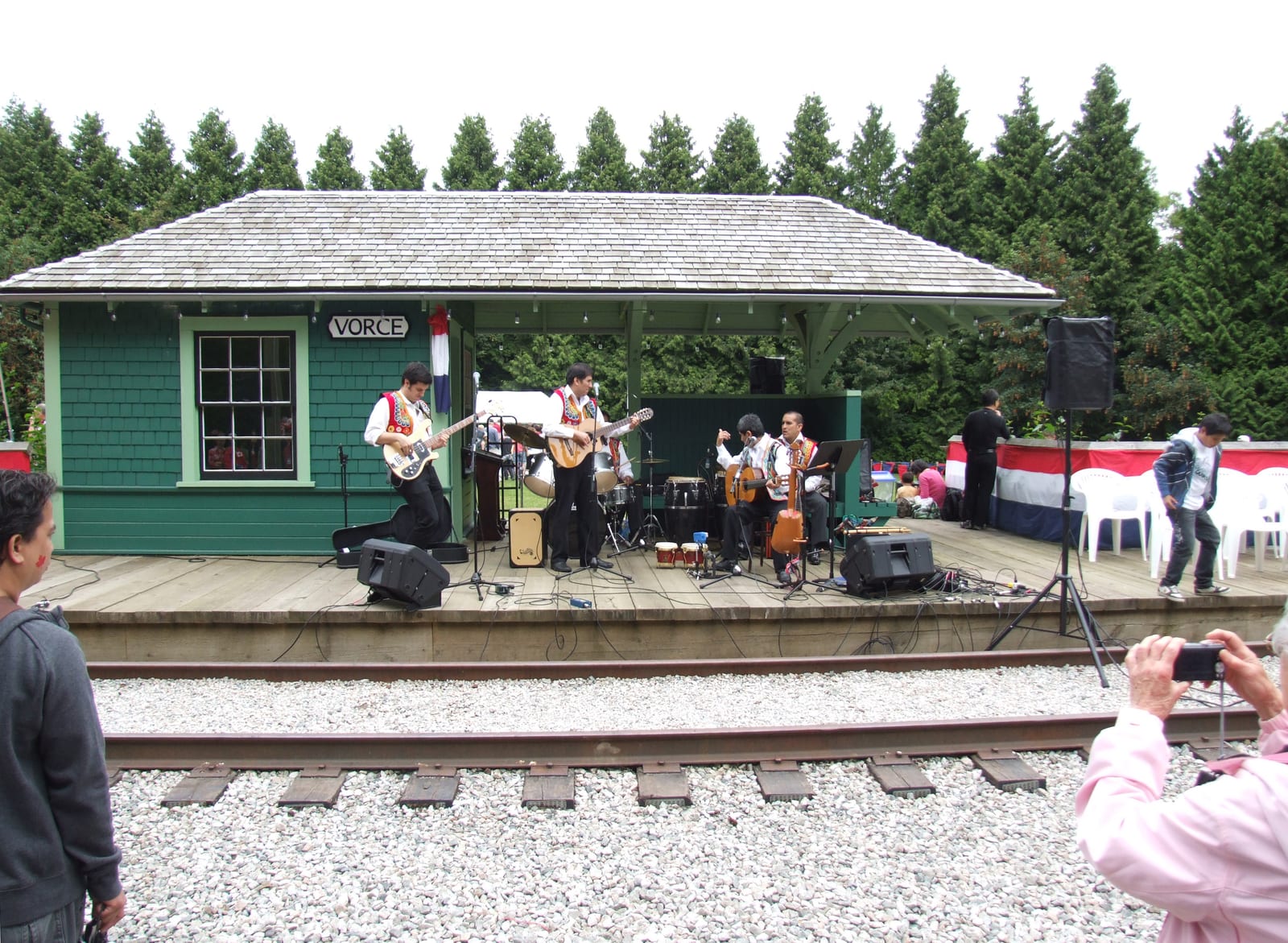
A small wooden tram shelter built in 1911 is the only piece of Burnaby's interurban railway still standing. It has moved twice by truck, and the engineer it was named for has all but vanished from the record.
Artom Butenko · 4 min read
Keys to the Centre
On 22 June 1956, a contractor handed Reeve Charles MacSorley the keys to a new municipal hall at 4949 Canada Way, near Deer Lake. The site had been chosen two years earlier by a simple rule: put the seat of government where neither half of Burnaby could complain it favoured the other.
Artom Butenko · 5 min read