What the Burnaby Mountain Holds: SFU in Winter
Arthur Erickson's mountaintop campus becomes something else in January—a stark landscape of shadows and ice that Hollywood keeps casting as the future.
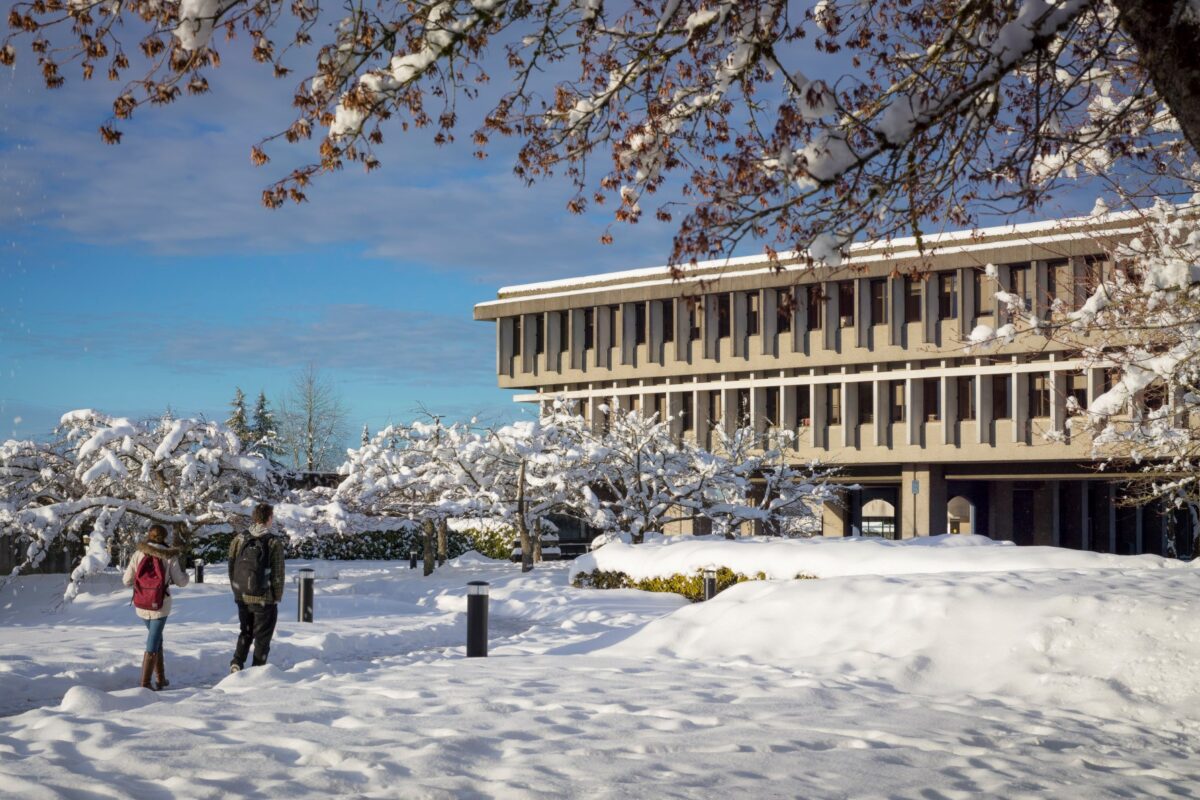
Arthur Erickson’s SFU in winter — stark, geometric, and exactly as intended
Drive up Burnaby Mountain in January when snow is forecast and Simon Fraser University becomes a different place. The concrete stays cold. The courtyards offer little shelter. Ice collects on the exposed walkways. Students hunch their shoulders and move quickly between buildings.Arthur Erickson’s architecture — brutalist, angular, deliberate — was built for this. The campus opened in 1965, two years after he won the commission at age 38. His first major institutional project. The design is horizontal and geometric. Long concrete planes. Repeated columns. Open courtyards that funnel wind. In summer, the space feels monumental. In winter, exposure.
Erickson built SFU to sit on top of a mountain and make that visible.
In 1963, the provincial government announced a competition for British Columbia’s second public university. The site was a forested summit on Burnaby Mountain — 365 metres above sea level, with views across the Fraser Valley and the coast. Erickson entered with Geoffrey Massey. Their proposal beat out larger, more established firms.
Gordon Shrum, the university’s first chancellor, had insisted on the mountaintop location. “Architecture determines the nature, the inner philosophy of a university,” he wrote. Erickson’s response was a linear plan organized along a central spine — the Academic Quadrangle — with academic buildings branching symmetrically on either side. The materials were poured concrete, glass, and steel.
Erickson later described the design as a response to the site: “Building and mountain would appear to be part of each other.” In a separate interview, he acknowledged the climate directly: “The continuous covered walks between all parts of the university with the climate on the mountain here we felt was absolutely essential.”
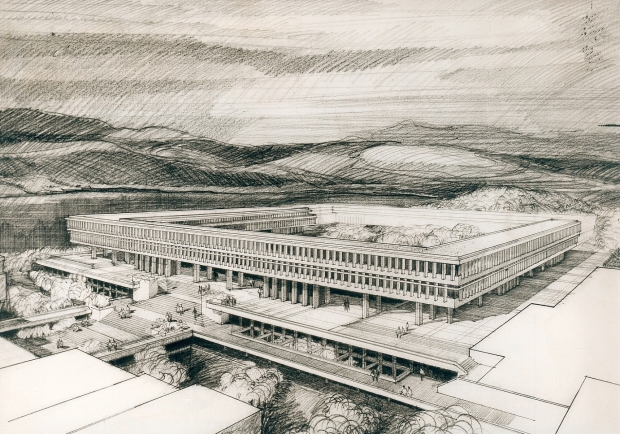
The style is now called brutalism, though Erickson resisted the label. Brutalism derives from béton brut, raw concrete. The aesthetic emphasizes structural honesty — materials exposed, forms expressing function, ornamentation minimal. Winter makes the concrete visible in a particular way.
Snow changes how you read brutalist concrete. There are no pitched roofs to shed it. The overhangs are shallow. The Academic Quadrangle — a long, open courtyard flanked by symmetrical buildings — becomes a wind tunnel. Snow blows horizontal across the concrete. Ice gathers in corners.
The campus has its own microclimate. Burnaby Mountain sits high enough that weather patterns differ from the city below. John Clague, SFU professor emeritus in Earth Sciences, explains: “In our temperate climate, our average winter temperatures are three to five degrees, but on Burnaby Mountain, temperatures could be zero or one. You can go from rain to snow really fast.” The mountain receives more than 50 centimetres of snow each year, mostly between December and March.
Students who attend SFU learn the routes. Which walkways are covered. Which stairwells hold heat. Where to cut through buildings to avoid the courtyards. Concrete holds cold. The open plan prioritizes sightlines and spatial drama. The repeated colonnades — one of Erickson’s signature gestures — create rhythm but little warmth.
When snowstorms hit, the relationship between students and architecture becomes a subject of public grievance. In January 2020, with transit running only essential services due to “dangerous road conditions,” SFU kept the campus open. Students took to Twitter: “On my way down the mountain two cars driving slowly drove off the road.” Another: “My friend said that she tried to go up the mountain this morning and she saw cars rolling backwards so she turned around.” The university now holds an annual “WinterReady” event each November to prepare the community for conditions that, elsewhere in Metro Vancouver, would be considered unusual.
The geometry becomes clearer in snow. The palette simplifies: concrete, white, shadow. The horizontal lines sharpen. The courtyards feel larger, emptier, more deliberate. What reads as monumental in summer becomes stark in winter.Film crews have noticed this for decades.
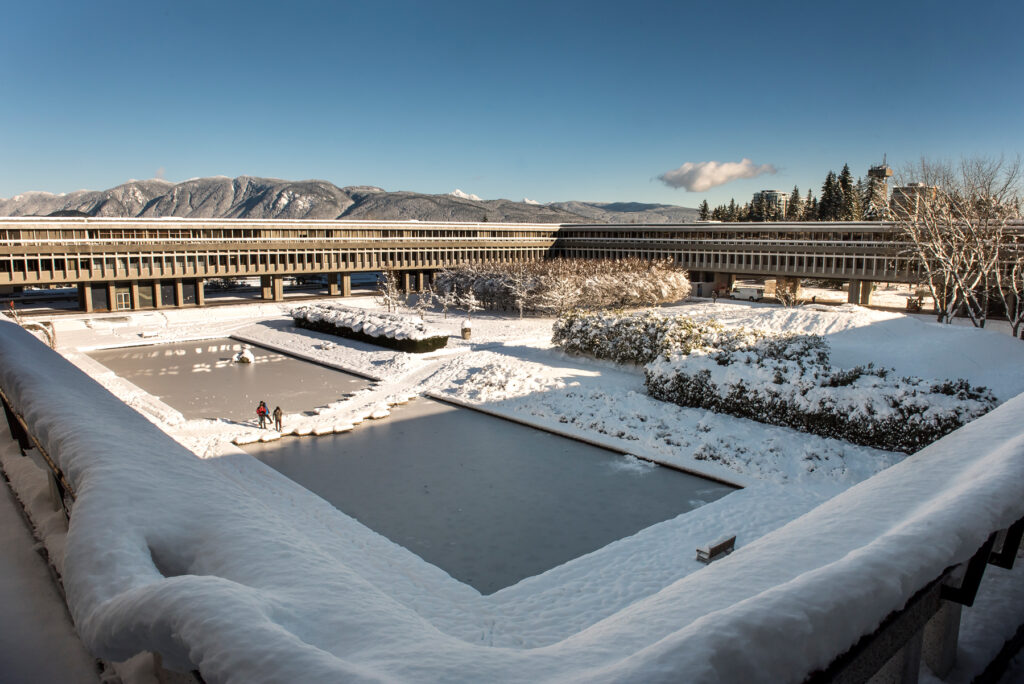
SFU has appeared in more than 200 film and television productions since the 1970s. It plays corporate headquarters, military installations, research facilities, government complexes. Rarely a university. The list includes Battlestar Galactica, The X-Files, Stargate SG-1, and The Imaginarium of Doctor Parnassus. The campus has doubled as a space station, a genetics lab, an underground bunker, a dystopian government building.
Winter filming adds to the appeal. Snow on brutalist concrete photographs as futuristic or alien. The spare geometry reads as deliberately constructed. The lack of ornamentation suggests control, efficiency, authority. A snowbound SFU looks like the kind of place where decisions about the future happen behind closed doors.
There’s an irony here. Erickson intended SFU as a humanist space, organized around communal gathering in the quadrangle. He spoke about creating an academic agora, a place for debate and exchange. Film productions use it as backdrop for surveillance states, totalitarian regimes, corporate dystopias. The same architecture supports both readings. The geometry is neutral that way.
The W.A.C. Bennett Library, completed in 1965, remains one of the most distinctive spaces on campus. The reading room is a large, open volume under a coffered concrete ceiling. Natural light enters from clerestory windows. In winter, the room stays dim most of the day. Students use desk lamps. The concrete ceiling amplifies sound — footsteps, chairs scraping, whispered conversations.
Most of SFU’s 30,000 students commute. The university operates shuttle buses from the Production Way SkyTrain station because driving up the mountain in winter is difficult. During snow events, the campus sometimes closes. When classes continue, attendance drops. Students who live off-mountain skip the trip. Those who come describe the campus as quieter, emptier, almost abandoned.
Renovations over the decades have added carpet, updated lighting, improved climate control. The core structure remains. Concrete. Glass. Geometry.
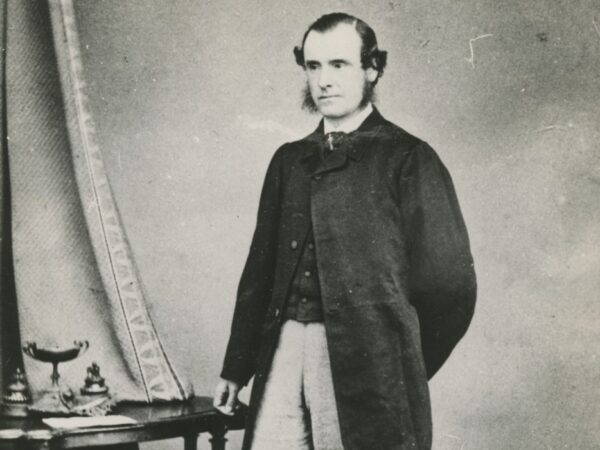
Erickson died in 2009. SFU was his breakthrough project. He went on to design the Museum of Anthropology at UBC, the Canadian Embassy in Washington, buildings across Canada and internationally. His legacy draws debate. Some view him as one of Canada’s most important architects. Others critique his work as impractical, uncomfortable, disconnected from user needs.
SFU embodies that debate. The campus is visually striking. It photographs well. Students complain about the cold, the wind, the long exposed walks between buildings. Architects admire the spatial composition. The Academic Quadrangle remains the core — still the most photographed part of campus, still used as a filming location.
In January, it becomes that stark, angular landscape where concrete meets snow. Students cross the quad with their heads down, moving fast. The wind cuts through. The space was designed to be seen, to be recognized, to assert the idea of a university as something monumental and permanent.
In winter, it succeeds. The campus becomes exactly what Erickson intended: architecture that holds its form against the weather.
Whether that makes it comfortable is another question entirely.

Comments
Join the conversation! Please log in or register to comment.
Log In to Comment